
New to the Florida Rum Society (or Rum in general)? Here are some places to start…
How to Learn
- Ask questions in the FRS Facebook Group. Our goal is to be a welcoming and rum education focused community. Please ask questions and our members will help guide
- Be part of FRS In-Person or Virtual Events. Join the Facebook Group and sign up for our e-mail newsletter so you always know what’s going on.
- There are some great books on Rum, check these out on Amazon: RUM BOOKS
Beginner Bottles
Rum is an extremely diverse spirit with different types, styles, flavor profiles, ect. Each rum lover paves their own journey but below are some highly recommended jumping off points.
Brands to Consider for Cocktail Rums (expression recommendations in parenthesis):
- Appleton Estate (8 Year)
- Chairman’s Reserve (Forgotten Casks)
- Grander Panama Rum (Cane Harvest)
- Hamilton (Demerara 151, Florida Rum Society Blend)
- Hampden (Probitas, Rum Fire)
- Holmes Cay (Heritage Blend)
- Pere Labat (59)
- Planteray (OFTD)
- Privateer (Navy Yard, Queen’s Share)
- Rhum Clement (Canne Bleue)
- Rhum J.M (50%, Terroir Volcanique, XO)
- Worthy Park (Overproof, 109)
Bottles for Sipping:
- Any Florida Rum Society Single Barrel Selection
- Appleton Estate 12 Year
- Worthy Park Single Estate Rum
- Hampden Great House
- Privateer Letter of Marque (FRS Selections if possible)
- Holmes Cay Single Barrels (FRS Selections if possible)
- Down Island Spirits Single Barrels (FRS Selections if possible)
- Grander Panama Rum (Trophy Release, FRS Selections if possible)
Where to Buy:
Unfortunately, large liquor store chains rarely have the rums that we, as rum enthusiasts, are looking for. The FRS continues to strive for more diverse and quality rum selections in local stores. Our Fourth Barrel Merchant Members have promised to try to bring in many of the bottles above as well as, whenever possible, Florida Rum Society special selections. Find a complete list of them on our Fourth Barrel Page. Please visit and support them if there is one in your area. Also, if you have a store that you think should be added then please also show them the site.
We have also partnered with Curiada who has asked the Florida Rum Society’s help in curating the most amazing online rum selection in the country! Visit the FRS Collection on their site and check back often for updates (look for FREE SHIPPING specials as well)
This is only a jumping off point but I hope it helps you get started! Check out the links below to get yourself 100% set up! Welcome to the FRS and the beautiful world of rum!
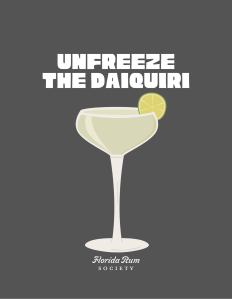
The Original Cuban Daiquiri… one of the simplest and most perfect ways to enjoy rum. It was extremely popular before the Cuban Embargo in 1958 (actually was John F. Kennedy’s favorite cocktail). Since then, at least in the U.S., it has been replaced by frozen, slushie, syrupy, overly sweet cocktails by the same name. The FRS is on a mission to “UNFREEZE the DAIQUIRI” by pushing for cocktail bars to bring back this classic.
Standard Recipe:
- 2 oz Lightly Aged Rum
- 3/4 oz Freshly Squeeze Lime Juice
- 1/2 oz Simple Syrup (2:1 sugar to water)
- Shake all ingredients with lots of ice until cold, strain and serve up in a coupe glass, fall in love
Basic Rum Terms
- Additives: Substances added to rum during the production process, such as flavorings, sweeteners, or colorants, which are sometimes used to enhance the taste and appearance of the final product, but can also be added to try to hide low quality distillates.
- Aging: The process of maturing rum in wooden casks, which enhances its flavor, color, and aroma. Aging can take place in tropical or cooler climates, with tropical aging generally resulting in faster maturation.
- Añejo: Spanish for “aged.” Añejo rum is aged for at least one year in oak barrels.
- Angostura Bitters: A concentrated herbal bitters used in cocktails, often paired with rum-based drinks like the classic Rum Punch or Old Cuban.
- Barrel Strength: Rum that is bottled directly from the barrel without dilution, often with a higher proof and more intense flavors.
- Blanco: Spanish for “white.” Blanco rum is unaged or lightly aged rum.
- Blended Rum: A type of rum made by combining different rums, often from various distilleries, to create a consistent flavor profile.
- Cachaça: A Brazilian spirit similar to rum but made from fermented sugarcane juice instead of molasses. It’s a key ingredient in the Caipirinha cocktail.
- Column Still: A type of still used in rum distillation that is more efficient than a pot still, producing a lighter, cleaner spirit with higher alcohol content.
- Demerara: A type of rum from Guyana. Demerara rum is typically aged in oak barrels for at least two years.
- Dunder: The residue left over after distillation of rum, which contains yeast and bacteria that help with fermentation in traditional rum-making processes, especially in the production of Jamaican rum.
- Esters: Volatile compounds formed during fermentation and aging, responsible for many of the fruity and floral aromas in rum.
- Fermentation: The process where yeast converts sugars into alcohol, often influenced by the environment and the type of yeast used, giving each rum its unique characteristics.
- Flavored Rum: Rum that has been infused with fruit, spices, or other botanicals to create distinct flavors, such as coconut rum or spiced rum.
- Heads: The initial distillate collected during the distillation process, which contains undesirable compounds and is usually discarded.
- Hearts: The middle portion of the distillate, which is the most desirable part and is kept for aging or bottling.
- High-Esters Rum: A style of rum, particularly from Jamaica, known for its high levels of esters, which contribute to strong, fruity, and often funky flavors.
- Hogo: A term used to describe the potent, funky aroma found in some rums, especially those from Jamaica, often caused by the use of wild yeasts during fermentation.
- Molasses: A byproduct of sugar production used in many rums to provide the sugar source for fermentation. It imparts rich, deep flavors to the final spirit.
- Navy Strength: Rum that is bottled at 57% ABV (114 proof).
- Overproof: Rum that is bottled at more than 57% ABV (114 proof).
- Pot Still: A type of still that uses a batch distillation process, producing more flavorful, complex, and heavier spirits compared to column stills.
- Proof: A measure of the alcohol content of a spirit, calculated as twice the percentage of alcohol by volume (ABV). For example, a rum with 40% ABV is 80 proof.
- Rhum: The French term for rum, often used to refer to rum made from fresh sugarcane juice, particularly in the French Caribbean (e.g., rhum agricole).
- Rhum Agricole: A style of rum made from fresh sugarcane juice, primarily produced in the French Caribbean, such as Martinique, known for its grassy, herbal flavors.
- Rum Runner: A term used for smugglers who illegally transported rum, often during Prohibition, or for rum-based cocktails like the “Rum Runner” drink.
- Single Barrel: Rum that comes from one specific barrel, rather than being a blend of several barrels, resulting in unique characteristics tied to the aging process of that barrel.
- Single Estate: Rum produced entirely from the sugarcane grown on a single estate, which often imparts a unique character to the spirit.
- Simple Syrup: A sweet syrup made by dissolving sugar in water, commonly used in cocktails to add sweetness.
- Small Batch: Rum made in small quantities, often with more attention to quality and flavor than mass-produced rums.
- Sipping Rum: Rum that is meant to be enjoyed neat or on the rocks.
- Solera: A system of aging rum where older rum is blended with younger rum in a series of barrels or casks to maintain consistency in flavor while allowing for some complexity.
- Sugarcane: The plant from which rum is derived, providing the sugars needed for fermentation. The type of sugarcane and how it’s processed can influence the flavor of the rum.
- Tails: The final portion of the distillate, which contains undesirable compounds and is typically discarded or redistilled.
- Tropical Aging: Aging rum in tropical climates, where the higher temperatures accelerate the maturation process, resulting in a different flavor profile than rum aged in cooler climates.
 Florida Rum Society